
The Dokkodō.
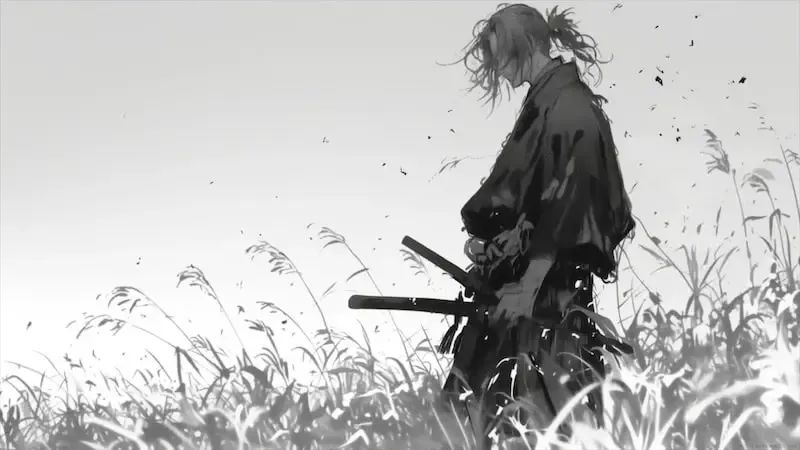
"Once you know the Way broadly, you can see it in all things." — Miyamoto Musashi
I'm going to write more book commentaries...
Not exhaustive reviews, nor compilation lists. I don't want to support the individual folly of reading a book review and pretending that you've actually read the book. Reading the book is the joy.
So I'll plant a few seeds—choice words on the tomes that have become cornerstones in my life.
I’ve grown tired of seeing the same cliché titles on every YouTubers '50 Must-Read Books’ list they use to capture your email and put you into a drip funnel to sell you AG1 supplements.
They all follow the same script:
- Taken on by a big publishing house, made to be 200+ pages longer than necessary.
- Discuss one trite idea, with a cleverly branded name hot off the presses from their ad agency.
- Ghostwritten by the lovely folks at Scribe or similar, for a cool $30k price tag.
My recent return to this—covering The Way of the Superior Man—seemed to land well. I have an older review of Finite & Infinite Games floating around in the digital ether. Plus, a few pieces sharing my annual reading adventures (2023, 2024, 2025 incoming…).
Walking around my room this morning on a majestic Mayan Monday, my eyes landed on one of 3 things I wrote out and taped to my wall: The Dokkodō.
It shares the podium alongside Frank Herbert’s legendary quote on fear from the Dune series, and the Bushidō, samurai code of virtues.
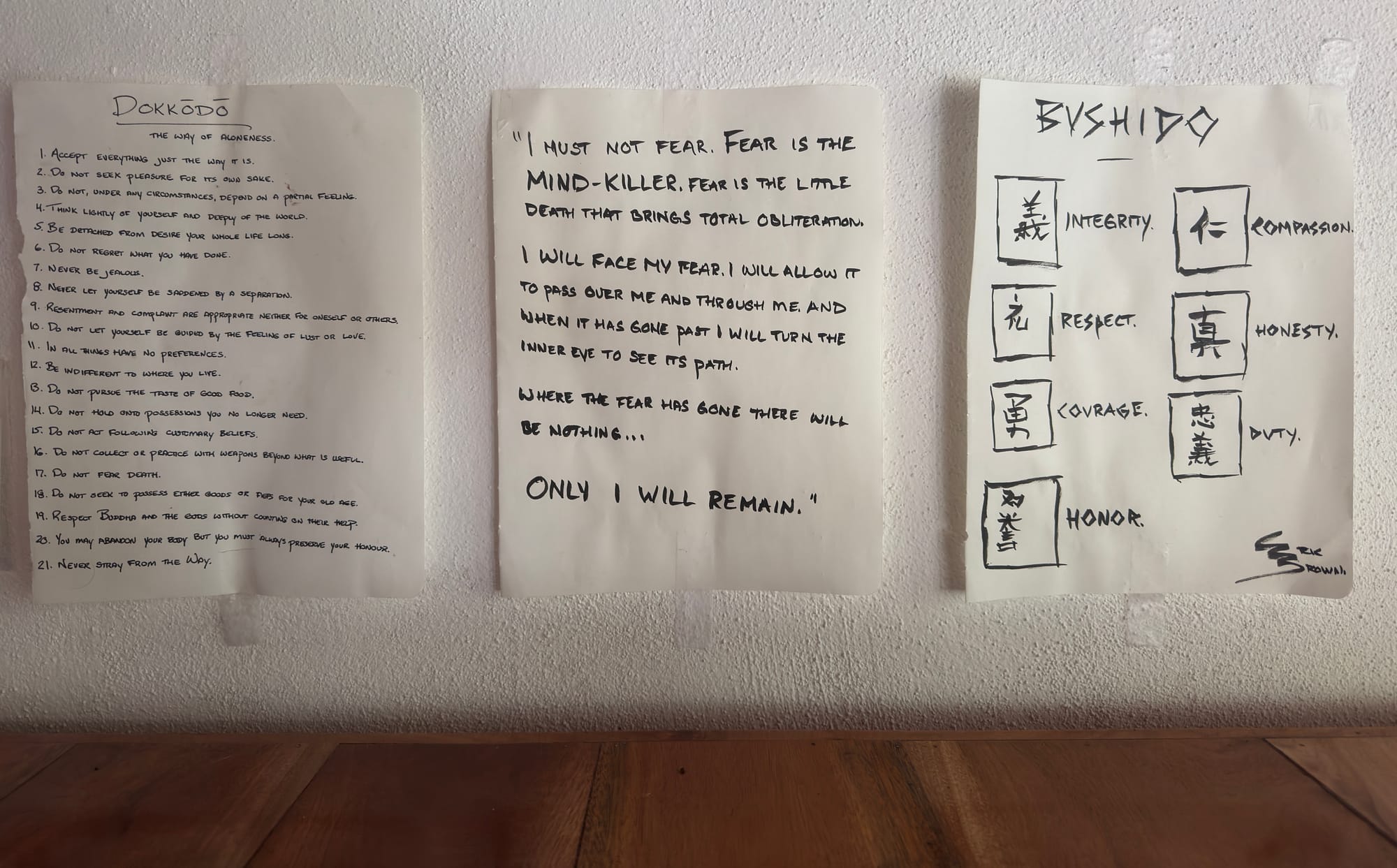
Musashi’s Dokkodō isn’t a book persay. Only 21 aphoristic statements. Though it packs more wisdom and challenge into those 21 lines than most modern self-help authors can bring to bear in the entire corpus of their lives' work.
Of course, Musashi was a unique character. Almost unrelatable in his extremity. The most famous swordsman of Japan, a wandering samurai (ronin), who lived an extremely ascetic life.
Toward the end of his life he took refuge in a cave, where he would later pass away, and penned his two canonical pieces: the Go Rin No Sho (Book of Five Rings), and The Dokkodō (Way of Aloneness).
The brilliance of Musashi’s work is that while you can read this in 5 minutes or less, integrating it and mastering the challenge that each maxim presents is the work of a lifetime. It’s inexhaustible.
Read this two years later, and 3 different statements will stand out to you. Two years more, and new ones reveal themselves with fresh, incisive wisdom. That is the true beauty of real masterpieces.
And for the astute observer—alongside the martial arts influence like Bushidō, Judō, Kendō—Musashi's Dokkodō has also been a central inspiration behind my thinking on the Yakudō: Way of Medicine.
 Eric Brown

The Dokkodō (Way of Walking Alone).
- Accept everything just the way it is.
- Do not seek pleasure for its own sake.
- Do not, under any circumstances, depend on a partial feeling.
- Think lightly of yourself and deeply of the world.
- Be detached from desire your whole life long.
- Do not regret what you have done.
- Never be jealous.
- Never let yourself be saddened by a separation.
- Resentment and complaint are appropriate neither for oneself nor others.
- Do not let yourself be guided by the feeling of lust or love.
- In all things have no preferences.
- Be indifferent to where you live.
- Do not pursue the taste of good food.
- Do not hold on to possessions you no longer need.
- Do not act following customary beliefs.
- Do not collect or practice with weapons beyond what is useful.
- Do not fear death.
- Do not seek to possess either goods or fiefs for your old age.
- Respect Buddha and the gods without counting on their help.
- You may abandon your own body, but you must always preserve your honor.
- Never stray from the Way.
Here is another translation that is a little easier to digest:
- Accept things as they are, and act accordingly.
- Do not be distracted by seeking pleasure.
- Approach everything and everyone with impartiality.
- Don't take yourself too seriously; but be serious about others, and the world.
- Do not be attached to your desires.
- Have no regrets.
- Do not be jealous.
- Do not dwell on those you cannot be with.
- Do not bear grudges or be resentful.
- Do not be a fool for love.
- Do not judge or make choices based on attraction or repulsion.
- Do not dwell on places you cannot be; "wherever you go, there you are."
- Do not make choices based on the taste of food; eat to live.
- Do not cling to things that are no longer useful to you.
- Do not be bound by custom or tradition; act as your own reason and conscience dictate.
- Do not waste time or resources acquiring goods or knowledge that are not useful to you.
- Do not let fear of death prevent you from living.
- Do not store up treasures against your old age; live now.
- Respect the gods, but do not depend on them.
- Protect your reputation; "death before dishonor."
- Never stray from what you know is right.
- #3: 'Do not depend on partial feelings' is taking center stage in my psyche. To borrow a more modern interpretation from Derek Sivers, "if it's not hell yes, it's no."
- I’ve been wrestling deeply with #9: Resentment and complaint are appropriate neither for oneself nor others. This is an easy one to nod your head at in agreement, but quite difficult to embody in practice.
- #6 on regret and #16, which rings with the true spirit of minimalism, are potent catalysts for transformation.
- #1: Accept Reality is a complete path! It is the beginning, end, and vehicle of a total self-mastery journey.
If you have a knee-jerk reaction to any of these, it’s worth meditating on them further.
“What’s the problem of pursuing the taste of good food!?” you cry out. Then the obesity epidemic, the virtue of self-restraint, what is truly worthy pursuing in life, what you orient toward, and the matter of keeping desire in its proper place all arise, and the living wisdom of Mushashi’s Way reveals itself to you in ever-deepening layers.
While the Dokkodō may not be the Way of Being that appeals to everyone, or is perfectly appropriate for your circumstances, there is always something hidden within these 21 lines that propels you forward on your journey of self-mastery.
That is quite a feat for something written alone in a cave 372 years ago.
Never stray from the Way,
EB. ⛩️
ps: If you want to go a bit deeper, 'Musashi' is a historical fiction of Musashi's life written by Eiji Yoshikawa. It's one of my favourites. A great read regardless of your interest in Musashi himself.
No spam, no sharing to third party. Only you and me.